




Creative Sentencing & Diversion Programs, Michigan Criminal Defense
A guilty finding does not have to mean a destroyed career. Diversion programs, alternative sentencing, and strategic mitigation protect what matters most beyond the courtroom. A guilty finding doesn't mean a destroyed career.
Creative Sentencing
& Advocacy
Criminal defense is not only about winning at trial. For many clients, the most important outcome is protecting a career, a license, a security clearance, or a family. That requires advocacy that begins long before sentencing and extends far beyond the criminal docket.
Most criminal defense focuses on the binary: guilty or not guilty. But the range of outcomes between a full acquittal and a straight guilty plea, with all of its collateral consequences, is wider than most clients ever learn. Michigan law provides a toolkit of diversion programs, deferred adjudications, alternative sentencing structures, and professional mitigation strategies that experienced criminal defense attorneys use to reshape outcomes in ways that preserve what matters most to the client.

For a CDL driver, an RN, a teacher, or a federal contractor, the question is rarely "will I go to jail?", it is "will I keep my livelihood?" Those outcomes are determined by what happens in pre-sentencing advocacy, plea negotiation, and structured dispositions that a court will accept. Every case is evaluated for every available alternative from the first consultation, because the window to pursue those options closes quickly once a case moves toward resolution on the prosecution's terms.
Makowski Legal's creative sentencing and advocacy practice covers Michigan's full range of statutory diversion programs, common-law and judicial alternative sentencing, professional license coordination, and mitigation narrative development for clients whose most important exposure is not the criminal sentence. It is everything that follows it.
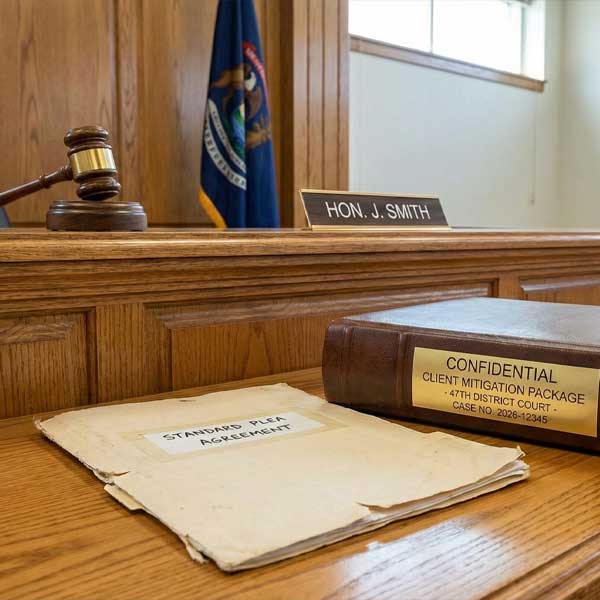
The Advocacy Differentiator
A guilty finding is a legal outcome. What that finding costs the client in lost licenses, clearances, careers, and family stability is determined by the quality of advocacy that surrounds it.
The standard criminal defense model treats sentencing as an afterthought, something that happens after the real work is done. The model at Makowski Legal treats sentencing advocacy as equal in importance to trial preparation, because for most clients, the collateral consequences of a conviction are more devastating than the sentence itself. A first-offense OWI that costs a CDL driver their commercial license is not a "good outcome" just because it avoided jail time. A domestic violence conviction that triggers mandatory firearms forfeiture is not a "minor matter" for a client with a CPL and a concealed carry lifestyle.
Mapping the full consequence landscape: Before any plea is discussed, every collateral consequence of every charge is mapped, including professional licensing, firearms rights, immigration status, security clearance, employment bars, mandatory reporting obligations, and sex offender registration. Many clients learn for the first time, after accepting a plea, that the offense they pled to carries consequences their attorney never identified. That map is built at the beginning of the case, not the end.
Pre-sentencing advocacy: Courts have discretion that prosecutors don't advertise. Pre-sentence investigation reports, judicial reference letters, treatment completion documentation, community impact evidence, and expert testimony on rehabilitative capacity all influence sentences in ways that no plea agreement can capture. Pre-sentencing packages are prepared for every case where the consequences justify it, and presented to judges in the language judges respond to.
The "guilty but not destroyed" outcome: For the right client in the right case, a guilty plea to a carefully negotiated charge, with a structured sentence and documented mitigation, produces a better outcome than a trial loss on the original charge. Creative advocacy identifies those cases, pursues them aggressively, and delivers outcomes that prosecutors and defense attorneys who don't think this way never achieve.
Alternative Programs
Michigan law provides statutory mechanisms that allow eligible defendants to resolve criminal charges without a permanent conviction, if they know how to access them and how to qualify.
Diversion programs, deferred adjudications, and alternative sentencing statutes exist because the Michigan legislature recognized that a permanent criminal conviction is not always the right tool for every offense or every offender. These programs are not entitlements. They require eligibility, prosecutorial cooperation in most cases, and court approval. The difference between a client who accesses them and one who doesn't is almost always the quality of their attorney's knowledge and advocacy.
MCL 333.7411 – Deferred Sentence for First-Offense Drug Charges: Section 7411 allows a court to defer proceedings and place a first-time drug offender on probation without entering a conviction. Upon successful completion, the charge is dismissed and the record is sealed from public view. 7411 is not available for delivery or manufacture charges, but covers possession offenses across virtually all controlled substance categories. Critically, 7411 does not prevent professional license consequences in all cases. The deferred proceedings still trigger LARA reporting obligations for some license types, and those implications are evaluated before recommending it.
HYTA – Holmes Youthful Trainee Act (MCL 762.11): HYTA allows defendants who were between the ages of 17 and 24 at the time of the offense to be assigned youthful trainee status without entering a conviction. Upon successful completion of probation, the case is dismissed and the record is closed, not expunged, but sealed from public access. HYTA is unavailable for certain serious offenses (felonies punishable by life, traffic offenses involving death, certain CSC charges), but covers an enormous range of charges for eligible defendants. HYTA status does not affect federal firearms disabilities in the same way a conviction does, which is significant for clients with firearms-related concerns.
MCL 769.4a – Deferred Sentence for First-Offense Domestic Violence: Section 769.4a provides a statutory deferral specifically for defendants charged with first-offense domestic violence. The court defers entry of a conviction and places the defendant on probation. Upon successful completion, the case is dismissed without a conviction on the record. 769.4a is only available once, only for first offenses, and requires the court's acceptance. Because a domestic violence conviction carries professional license consequences, firearms disabilities, and immigration exposure far beyond the criminal sentence itself, identifying and pursuing 769.4a eligibility from the outset is often the most important decision in the case.
MCL 771.1 – Delayed Sentence: Section 771.1 is a broad statutory mechanism that allows a court to delay sentencing and place a defendant on probation before any conviction is entered. If the defendant completes the terms successfully, the charges can be dismissed entirely. Unlike 7411 or HYTA, 771.1 is not offense-specific — it functions as a catch-all deferral available across a wide range of charges where no other statutory program applies. However, many counties and individual prosecutors maintain internal policies against recommending 771.1, and some courts rarely grant it without strong advocacy in support. Knowing which jurisdictions are receptive, which prosecutors will entertain it, and how to build the case for a judge's discretion is what separates a client who accesses this option from one who never hears it mentioned.
Diversion programs and sobriety courts: Michigan's diversion landscape also includes OWI sobriety court programs, mental health court diversion, veteran's treatment court, and county-level prosecutor diversion agreements that vary by jurisdiction. Makowski Legal knows which programs are available in which courts, which prosecutors support them, and what it takes to qualify a client for consideration. These programs can mean the difference between a conviction with collateral consequences and a dismissal with a clean record.

Mitigation Narratives
How creative advocacy shaped outcomes in cases where a conviction alone would have been devastating
Outcome Narratives
Federal CDL Disqualification Avoided Through Charge Reduction
A commercial truck driver with 22 years behind the wheel was charged with first-offense OWI after a traffic stop. A straight guilty plea would have triggered mandatory federal CDL disqualification, permanent loss of commercial driving privileges on a second offense, and one year on the first. The DataMaster calibration records were challenged, a procedural deviation in the arresting officer's field sobriety administration was identified, and a reduction to impaired driving (OWVI) was negotiated with a non-CDL-disqualifying disposition structure. The client kept his CDL, his employment, and his livelihood.
Result: CDL preserved, career intact7411 Deferral Coordinated With LARA Licensing Strategy
A registered nurse with a clean record was charged with first-offense controlled substance possession. The criminal exposure was manageable, a first-offense drug charge with no priors. The licensing exposure was not: any drug-related conviction, and in some cases even a deferral, triggers mandatory self-reporting to LARA's Bureau of Professional Licensing and an investigation that can result in license suspension. A 7411 deferred disposition was pursued while simultaneously coordinating a proactive voluntary disclosure and compliance plan with the client's nursing license counsel, structuring the criminal resolution and the licensing response together so neither undermined the other. The client completed probation, the charge was dismissed, and the nursing license was maintained with a monitored compliance agreement.
Result: Charge dismissed, license maintainedHYTA Status Preserved a Clean Record at 22
A 22-year-old client with no prior criminal history was charged with Assault with a Dangerous Weapon (Felonious Assault) arising from a bar confrontation. The charged offense, if convicted, would have created a permanent felony record blocking employment in healthcare, education, and licensed trades. HYTA assignment was secured over prosecutorial objection, a pre-sentencing mitigation package was presented documenting community ties, employment history, and absence of any pattern of violent behavior, and a probationary sentence the court accepted was structured. Upon successful completion, the case was closed, with no public record, no felony, and no disruption to a career that hadn't yet started.
Result: HYTA assigned, record sealed on completionSecurity Clearance Preserved Through Deferred Disposition and Mitigation Package
A federal contractor with an active Secret clearance was charged with misdemeanor domestic violence. A conviction would have triggered the federal Lautenberg Amendment, mandatory firearms prohibition and near-certain clearance revocation. A deferred prosecution agreement was negotiated with a structured anger management and counseling component; a comprehensive mitigation narrative was prepared for the client's facility security officer documenting the circumstances, the intervention undertaken, and the absence of any pattern of conduct; and the criminal resolution timeline was coordinated with the clearance adjudication calendar. The deferred case was dismissed after program completion; the clearance was maintained with conditions.
Result: No conviction, clearance retainedYour Outcome Starts With the Right Strategy
Creative advocacy requires identifying your full exposure, including criminal, professional, and collateral consequences, before the case resolves. The earlier we start, the more options remain available.
Get a Confidential Case Evaluation →